President Prabowo Subianto has set an ambitious 8% economic growth target by the end of his term in 2029. Achieving this requires an average acceleration of 0.6% points per year from the 5.03% baseline when he took office in October 2024. Such a leap is not unprecedented. South Korea, Singapore, and Taiwan achieved similar jumps during the 1960s to 1990s, often called “the East Asian Miracle.”
Yet the first three months of 2026 reveal just how difficult this path will be. On the surface, there are reasons for encouragement. Annual inflation dropped from 4.76% in February to 3.48% in March, falling back within Bank Indonesia’s target range. First-quarter tax revenue grew 20.7% year-on-year, reaching 394.8 trillion IDR.
Despite these gains, warning signs are mounting. The budget deficit through March widened to 240.1 trillion IDR, a 140.5% increase year-on-year. The rupiah broke past the Rp17,000 per dollar mark and capital outflows from Indonesia’s financial markets reached $1.1 billion. Indonesia must push for faster growth while carrying heavier fiscal burdens in a global environment filled with uncertainty.
Then, how should we read these contradictory signals? A clear assessment of the economy’s achievements and vulnerabilities is thus essential before pursuing that growth target.
Indonesian Stock Exchange building in Jakarta. Source : Wikimedia Commons
There are genuine reasons for optimism in Indonesia’s first-quarter performance. Tax revenue grew over 20% year-on-year through March, a sign that the government’s push for better compliance and administrative reform is gaining traction. Core inflation remained well within Bank Indonesia’s target range, suggesting that domestic demand pressures are manageable. The Ramadan and Eid al-Fitr season also provided a meaningful lift to consumer activity, with online spending reaching nearly Rp97 trillion in a month alone.
The banking sector tells a similarly encouraging story. Credit growth held steady and investment lending accelerated sharply. Banks maintain strong capital buffers well above regulatory minimums. This financial resilience gives Indonesia room to channel credit toward productive sectors without destabilizing the system.
Still, several structural challenges need careful attention. Government spending grew three times faster than revenue in the first quarter, pushing the primary balance back into deficit. Front-loading expenditure is a familiar fiscal strategy meant to jumpstart growth early in the year. But when the gap between spending and revenue widens this dramatically, it raises a critical question about whether this pace can be sustained without crowding out spending later in the budget cycle.
Consumer confidence surveys moreover remain firmly optimistic, yet Indonesians are actually spending a smaller share of their income and saving more. This disconnect matters. If households are confident but cautious, it suggests they may be responding to signals that surveys do not capture, such as rising living costs, employment uncertainty, or diminishing trust in the durability of the recovery.
The financial system also shows a worrying divergence. Credit for micro, small, and medium enterprises (MSMEs) contracted by 0.6% year-on-year, while corporate credit grew strongly at 14.74%. This gap in access to financing risks widening economic inequality across business scales. In online lending, the 90-day default rate (TWP90) jumped from 2.78% in February 2025 to 4.54% in February 2026, approaching the Financial Services Authority’s (OJK) tolerance limit of 5%.
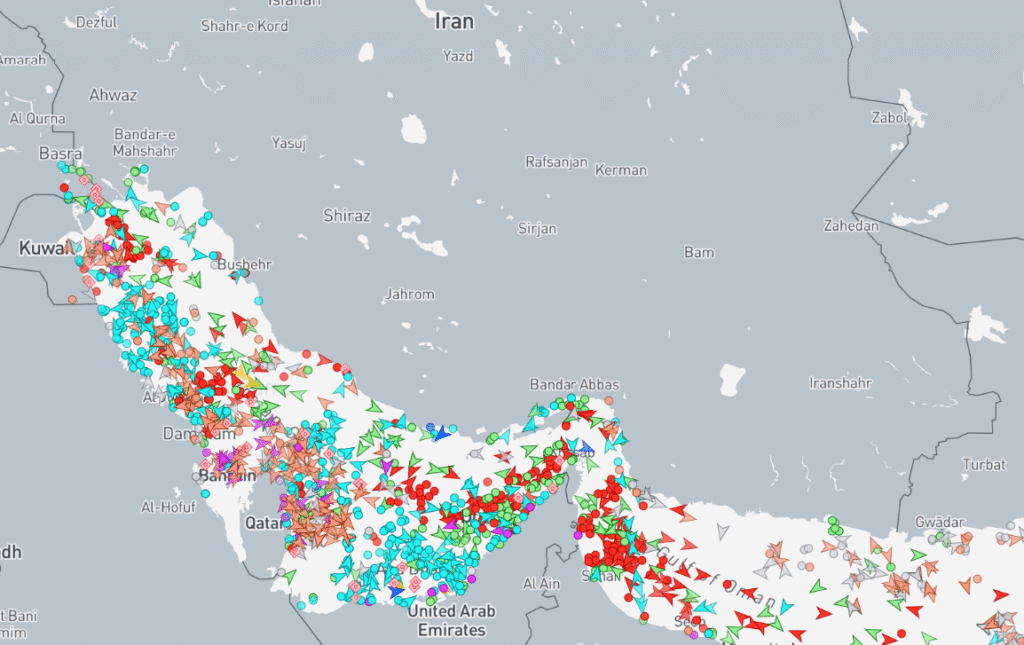
Ship traffic at the Strait of Hormuz. Source : Marine Traffic.
External headwinds compound these domestic vulnerabilities. The Middle East conflict has driven oil prices well above the state budget’s assumptions, threatening to inflate energy subsidy costs and further strain fiscal resources. Meanwhile, US import tariffs continue to weigh on Indonesia’s labor-intensive exports in textiles, footwear, and furniture. These are forces largely beyond Jakarta’s control, and they narrow the policy space available to economic managers regardless of how effectively domestic reforms are implemented.
Despite these challenges, Indonesia holds several advantages that many developing countries lack. First, the maturity of the national digital economic infrastructure, with QRIS penetration reaching micro-level businesses and an e-commerce ecosystem recording transaction volumes of tens of trillions of IDR per month, can be transformed into stronger fiscal policy tools and more equitable financial inclusion.
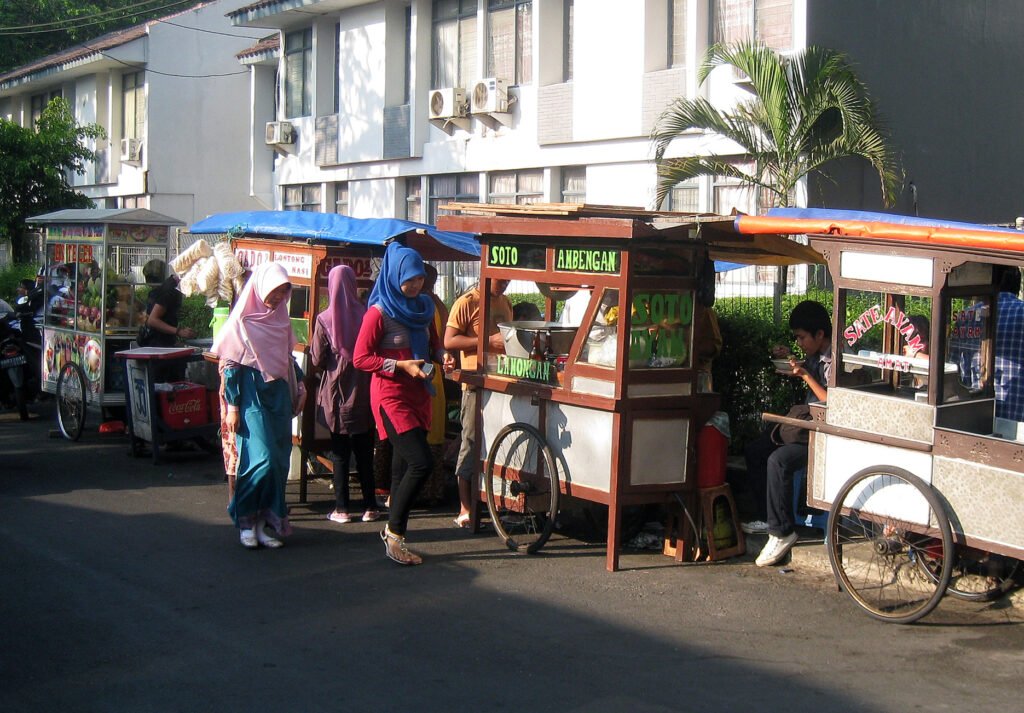
Street vendor carts in Jakarta. Source : Wikimedia Commons
Second, the informal economy, estimated to cover more than half of all national economic activity, holds great potential because every one percent of businesses successfully formalized would significantly expand the tax base without requiring rate adjustments. Third, Indonesia’s position as a leading producer of strategic commodities, from nickel to palm oil, gives it a comparative advantage amid the restructuring of global supply chains. Amid global uncertainty, these opportunities can be optimized to build a stronger economic foundation.
The 8% growth ambition reflects optimism about Indonesia’s potential. This spirit needs to be maintained but also supported by fiscal prudence, data transparency, and policy responsiveness to the real conditions of the people. Indonesia has proven its resilience through multiple crises, from 1998 to the 2020 pandemic. With wise management, today’s challenges are not insurmountable either.
Because in the end, what is at stake is not how fast economic growth numbers look on paper, but the quality of life of 280 million people who long for prosperity.
Achmad Hanif Imaduddin is Researcher at the Center of Reform on Economics (CORE Indonesia). The views expressed are personal.