The framing that ASEAN is a collective middle power is largely anchored in institutional diplomacy, strategic multi-alignment, and economic interdependence. Yet such a perspective risks underestimating another aspect of influence that is increasingly significant in the 2020s, which is the region’s evolving soft power landscape. ASEAN’s agency today is not confined to formal mechanisms such as the ASEAN Regional Forum or the East Asia Summit. It is also exercised through cultural circulation, digital publics, and transnational narratives that shape how the region is perceived, consumed, and contested globally. In this sense, ASEAN’s middle-powership is no longer purely institutional. It is also culturally diffused and networked.
A useful illustration emerges from the global reception of Raya and the Last Dragon. Although produced outside the region, the film draws extensively on Southeast Asian visual traditions, folklore, and moral frameworks. Its central narrative, revolving around fragmentation and the fragile reconstruction of trust, resonates strongly with ASEAN’s own structural condition. The fictional Kumandra, often interpreted as a metaphorical Southeast Asia, reflects a region defined not by homogeneity but by negotiated coexistence. The significance here lies less in authorship and more in representation. Southeast Asia’s cultural identity, even when mediated externally, becomes a symbolic resource that contributes to global imaginaries of the region. This is soft power operating not as direct projection, but as narrative diffusion.
Indonesian rapper “Rich Brian” signed to 88 rising. Source : Instagram/ @88rising
This dynamic is further amplified by the rise of trans-Asian cultural platforms such as 88rising. By curating artists across Asia and its diaspora, 88rising has created an ecosystem where Southeast Asian musicians increasingly share space with more established East Asian acts. Indonesian, Filipino, and Vietnamese performers are no longer peripheral participants but integral nodes within a broader Asian cultural network. What emerges is not a singular Southeast Asian identity, but a layered regional presence that reflects the organization’s own logic of unity in diversity. In contrast to traditional soft power models that depend on state-led branding, Southeast Asia’s influence here is mediated through collaboration, curation, and the market-driven flows of popular culture.
At the same time, the broader trajectory of “Far East” cultural expansion inadvertently created pathways for Southeast Asian visibility. East Asian popular culture’s global success normalized Asian aesthetics and narratives within international audiences, lowering the barriers for Southeast Asian content to gain recognition. Southeast Asia, in this context, operates as a secondary but increasingly significant node within a pre-existing cultural infrastructure. Rather than competing directly with dominant exporters, it benefits from proximity, adjacency, and the gradual diversification of global cultural demand.
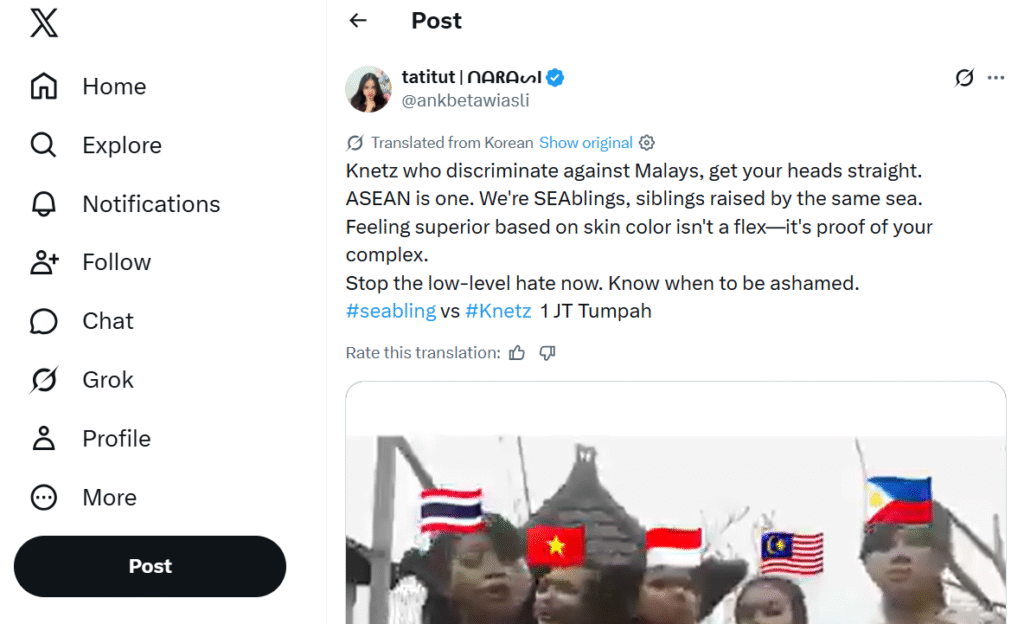
Tweet participation in the “Knetz” vs “SEAblings” phenomenon. Source : X.com
Perhaps the most telling development, however, lies in the behavior of digital communities. The interaction between South Korean netizens and Southeast Asian online audiences, often captured in the so-called Knetz versus “Sea-bling” phenomenon, illustrates the emergence of a more assertive Southeast Asian digital presence. These exchanges, while frequently informal and episodic, reveal a capacity for collective mobilization, narrative contestation, and identity assertion in transnational spaces. Unlike institutional diplomacy, which is constrained by consensus and protocol, these digital engagements operate with speed, scale, and emotional resonance. They represent a form of bottom-up soft power that ASEAN as an institution does not directly control, yet indirectly embodies.
Taken together, these developments suggest a recalibration of ASEAN’s middle-power identity. Soft power in this context is not centrally produced nor strategically orchestrated in a conventional sense. Instead, it emerges from distributed networks of cultural production, diasporic linkages, and algorithmically mediated visibility. ASEAN’s role is less that of a singular actor projecting influence outward, and more that of an enabling environment in which diverse forms of cultural expression can circulate and gain traction. This aligns with the organization’s broader diplomatic ethos, which prioritizes facilitation over imposition and coherence over uniformity.
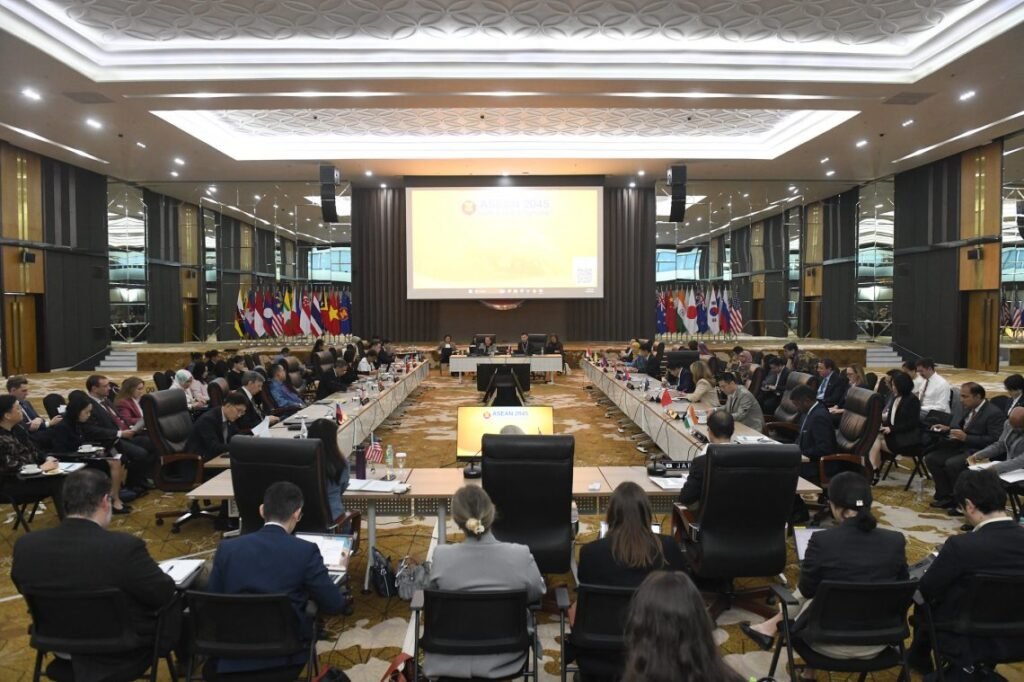
East Asia Summit (EAS) Ambassadors gather for the First Meeting of the EAS Group in 2026. Source : asean.org
Importantly, the very fragmentation that often constrains ASEAN’s institutional effectiveness may enhance its soft power resilience through its middle-powership. In an era where global audiences increasingly value plurality, authenticity, and hybridity, Southeast Asia’s diversity becomes an asset rather than a liability. Unlike major powers that rely on tightly curated national narratives, ASEAN’s cultural presence is inherently decentralized and adaptable. This makes it less vulnerable to reputational shocks and more capable of evolving alongside shifting global tastes.
Southeast Asia’s collective middle-powership, therefore, must be understood as operating across both formal and informal domains. It convenes major powers through institutional platforms while simultaneously permeating global consciousness through culture, media, and digital interaction. The challenge moving forward is not the absence of soft power resources, but the absence of a framework to recognize and integrate them. If ASEAN can bridge this gap, its role as a collective middle power will no longer be defined solely by its ability to manage great-power rivalry, but also by its capacity to shape the cultural and narrative terrain in which that rivalry unfolds.
Darynaufal Mulyaman is an assistant professor of international relations at Universitas Kristen Indonesia