In March 2026, King’s Global Institute for Women’s Leadership (GIWL) in collaboration with Ipsos released their International Women’s Day 2026 global survey data. It captures attitudes toward gender roles and equality across 29 countries, focusing on gen-z respondents. Taking a closer look at Indonesia’s results raises an important question: what does the world “feminism” mean to Indonesia?
The results are complementary to a different survey done by tirto.id and Jakpat in 2021. Respondents largely defined feminism as ‘gender equality’ and ‘strong and independent women’, with a minority claiming it as ‘liberal or westernized view,’ ‘extreme or angry movement’ and ‘anti men movement.’
These varied interpretations suggest that while feminism is largely understood as equality, at times it still carries negative connotations. Although the women’s rights movement has existed for decades in Indonesia, it is still largely a patriarchal society, with leadership roles dominated by men and traditional gender roles still highly promoted.
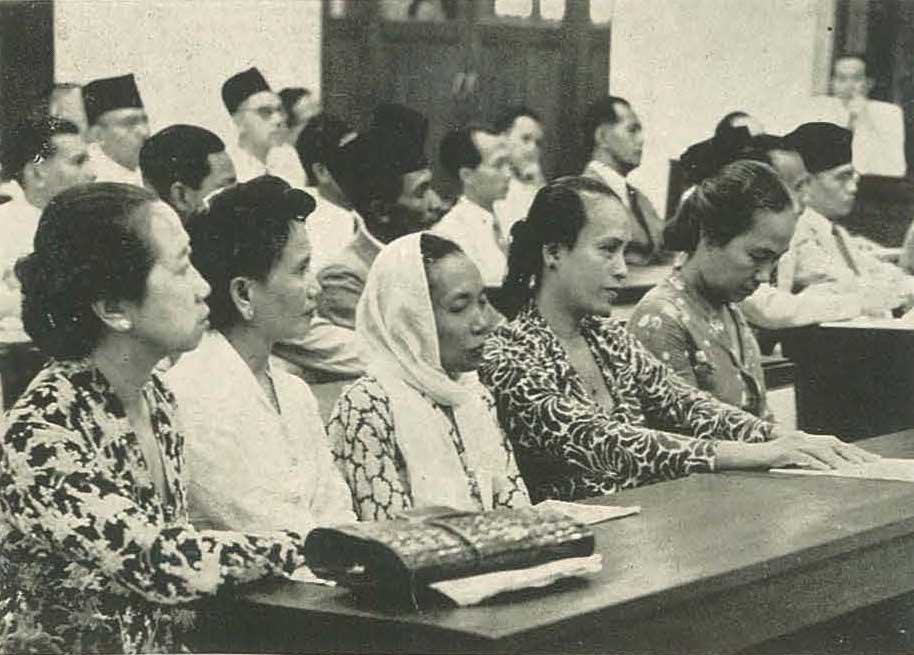
Female Indonesian parliamentarians in 1950. Source : Wikimedia Commons
Now let’s take a closer look into GIWL’s data. Nearly half of the respondents (43%) define themselves as a feminist, and the majority (64%) agrees women won’t achieve equality unless more female leaders are involved.
But, the results under the category ‘gender roles’ gives a deeper view into what Indonesians actually think. A big majority (83%) believes men should be most responsible for breadwinning, 66% agrees a wife should always obey her husband, and 67% agrees a husband should have the final word on important decision making in ‘his’ home. To highlight, out of all 29 countries Indonesian respondents scored the highest percentage in the mentioned categories.
The results can be drawn into a simple conclusion, on one hand, Indonesians express strong support for gender equality; on the other, traditional hierarchies within the household are still firmly established.
These results coincide with the wedding trends in the country. The Central Statistics Agency (BPS) recorded that in 2014 the number of marriages was 2,110,776, yet it went down almost by half in 2023 down to 1,577,255 marriages. Showing that the younger generations (gen-z and to some extent the millennials) are choosing to marry later, putting other priorities up front such as education, career and financial stability.
Taking the GIWL’s data into account, other reasons could also play crucial roles. Women are increasingly more selective of their partners, taking more agency in their decisions. As equal pay becomes more of the norm, the obligation to marry is no longer blaring. Marriage is no longer seen as a necessity – to gain visibility, stability and security, but instead seen as a choice contingent on equality.
Minang Groom and Bride, circa 1960. Source : Wikimedia Commons
Ultimately, gender equality is supported in principle, but resisted in practice. While gender equality is increasingly embraced, deeply rooted expectations about obedience, authority, and household roles remain largely unchanged. The challenge in Indonesia is no longer about awareness, but about transformation—translating progressive attitudes into lived realities. For a generation that values autonomy, partnership, and not hierarchy, this imbalance may continue to reshape not only marriage trends, but the very foundation of social norms in Indonesia.
Herza Nabilah is a researcher on foreign policy and women empowerment based in Indonesia