Marcos has weaponized international law against his political opponents, this action could be used against him or worse, Southeast Asian leaders could copy this tactic.
Editor – Southeast Asia Analyst.
Over the past week, the Philippines was laser focused on the International Criminal Court’s (ICC) hunt on Senator Ronald Dela Rosa who was missing from the public eye from November 2025. Dela Rosa resurfaced in May 2026 as he escaped arrest attempts by fleeing to the senate complex. There were reported stand offs, lockdowns and even gunfire that rang out as he stayed in senate custody.
The ICC pursuit comes after former President Duterte’s detainment in the Hague in March 2025 where he was charged with masterminding the “war on drugs” that involved mass extra judicial killings and other crimes against humanity of suspected drug dealers and in many cases even users across the archipelago during his administration. Dela Rosa who was the national chief of police is wanted for acting as Duterte’s enforcer.
Dela Rosa made multiple pleas to his supporters, fellow senators, the supreme court and even current President Marcos Jr. insisting that his arrest warrant is invalid as the Philippine pulled out of the ICC in 2019. He spoke to reporters teary eyed while appealing to Marcos Jr. to resist the ICC arrest process and cooperation with the Hague. To this, Dela Rosa’s lawyers vowed to exhaust every other legal option left.
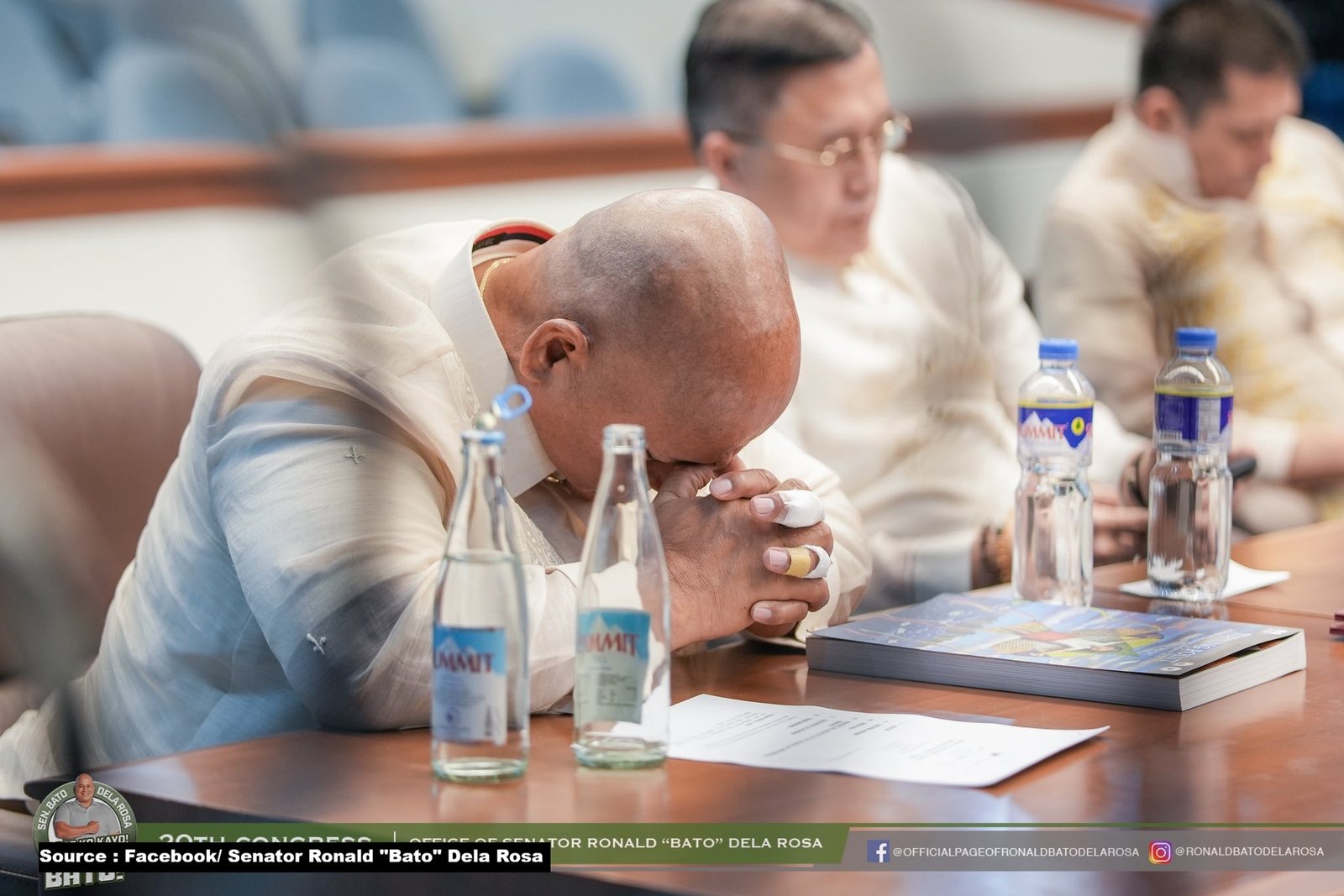
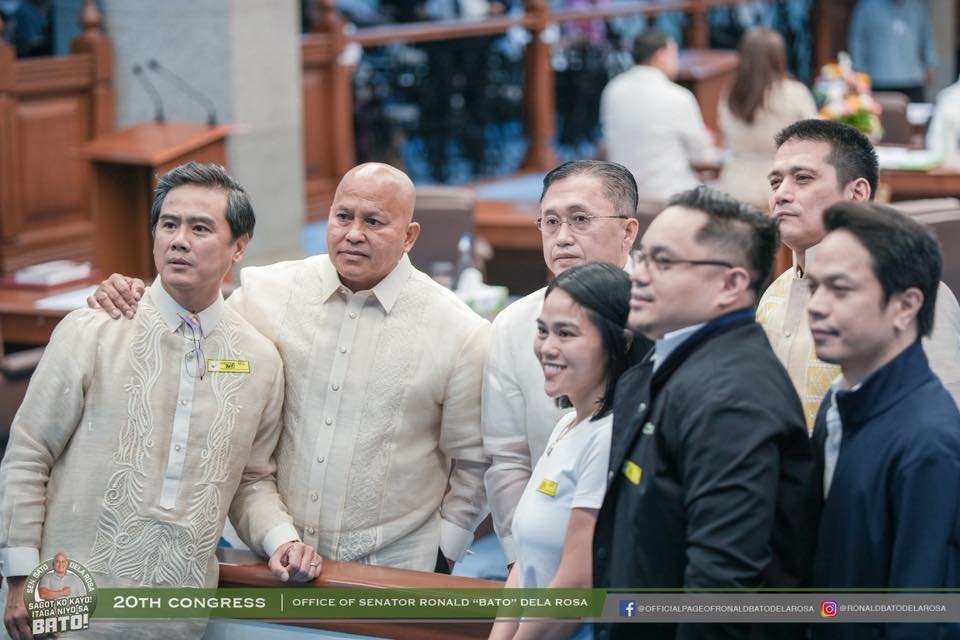
Senator Dela Rosa and his fellow Senators. Source : Facebook/ Senator Ronald “Bato” Dela Rosa
Despite this the department of justice and the supreme court have denied his request claiming that the Philippine was still an ICC member when the war on drugs raged on and that the withdrawal does not remove past obligations. They added that Philippine domestic law allow cooperation with international bodies and that there is no reason to place a temporary restraining order to prevent his arrest. Not all government officials had a united voice on this matter as Interior and Local Government Secretary Jonvic Remulla, a known ally of Duterte, denied the existence of the ICC warrant.
While Dela Rosa was able to mobilize a considerable number of supporters, communities online were in a rather celebratory mood, claiming that its “open season” for the top cop turned senator. Others were more reflective, speculating it is Marcos Jr. ‘s scheme behind all this. Besides the fact that the ICC relies on local authorities to make arrests, there is a hefty amount of reasonable doubt for this assumption.
Translation : Yey we are now all together hahahaha. Source : Reddit/ YellowTangerine08
The union between the Marcos and Duterte dynasties during the 2022 Philippine presidential election was never based on shared values but a marriage of convenience to secure a landslide victory. The cracks in the alliance became apparent in early 2025 when vice president Sara Duterte was impeached by Marcos Jr.’s allies in the senate in February 2025. A month after this, her father, the former president Duterte, was arrested by the ICC and detained in Hague.
Following this was rallying cries from the Duterte camp, another impeachment of Sara Duterte, her announcement for candidacy in the 2028 presidential election and most recently the Dela Rosa brouhaha.
Speculation on the reasons behind the purge against the Duterte clan and its allies primarily lies to discourage more from joining Sara Duterte’s presidential campaign, who remains a polarizing yet wildly popular party that dominates early polls.
Vice President Sara Duterte and her supporters. Source : Facebook/ Inday Sara Duterte
The blatant irony of the situation is strikingly obvious. There is no doubt that Duterte and his allies committed crimes against humanity during their tenure. However it is also clear that Marcos Jr. opened the doors for the ICC to root out his allies as soon as they became an inconvenience and worse a threat against his dynasty. The irony becomes even more glaring considering that the Duterte dynasty amassed its wealth from massive human rights abuses perpetrated by Marcos Jr’s father Ferdinand Marcos’s 2 decade long dictatorship.
While weaponizing domestic law to persecute political rivals is nothing unheard of, appropriating international law for the head of state’s benefit might be a new occurrence in Southeast Asia or even perhaps Asia, although it has to be noted that most Southeast Asian countries are not ICC members.
The dangers in this action is not only limited to further damaging whatever credibility is left of international law. The Marcos Jr. administration must realize that future presidents can use this strategy against their rivals or perhaps even against Marcos Jr. himself, possibly by Sara Duterte if she wins the presidency.
This even risks starting a trend of Southeast Asian countries weaponizing international law, against their rivals. Given that the current Indonesian president used painfully similar strategies as his Filipino counterpart to win himself a tenure, it is not outside the realm of possibility that he will use similar methods despite his aversion to foreign tactics.
A considerable number of Filipinos are rejoicing over this occurrence. It is understandable that seeing a mass murderer at the brink of his downfall brings catharsis, they must also realise that they could be victims of domestic and international law weaponized against them unless the those who wield it are kept in check.
Han Kyeol Kim is an Editor in Southeast Asia Analyst