The region’s future prosperity will almost certainly still depend on growth, which is becoming less predictable and its sources are becoming more fluid.
Editor – Southeast Asia Analyst
For decades, the debate surrounding Southeast Asia’s development trajectory was haunted by a deceptively simple question: which countries will escape the middle-income trap? This framing is becoming less useful. The problem is whether they can continue to find new sources of productivity and growth as the foundations of their previous success change.
The region’s developmental story has traditionally been told as a ladder. Countries move from agriculture to manufacturing, from low wages to higher wages, from basic assembly to sophisticated production, and eventually from middle-income to advanced-economy status. That model captures much of Southeast Asia’s remarkable economic transformation over the past half-century. But the next phase will be more complicated, since the sources of comparative advantage are changing too quickly.
Palm oil plantation in Malaysia in 2007. Source : Wikipedia
Artificial intelligence (AI), the energy transition, demographic change, geopolitical fragmentation and technological competition are already reshaping the conditions under which ASEAN economies compete. Global supply chains are being reorganised, but not essentially in ways that ensure the region will capture more value. Now, it is a question of its economies adapting quickly enough to where the next sources of growth are emerging.
Adaptation here means having the institutions and capabilities to move capital towards more productive activities, equip workers with new skills, build infrastructure ahead of emerging demand, and adjust regulations as technologies and markets change. It also means being able to change course when an earlier development strategy stops delivering the same returns.
This is crucial as the region enters a new phase of technological change. Consider artificial intelligence. Across Southeast Asia, the discussion around AI often focuses on the risks it poses to employment and social disruption. Those risks are real, but the larger opportunity is productivity.
Street food vendor in Vietnam. Source : Wikipedia
Millions of Southeast Asians work in small businesses, informal employment and low-productivity services. The ability to deploy AI in education, healthcare, agriculture, fintech and public administration could transform productivity well before these economies become high-income.
But capturing those gains will rely on whether governments have the complementary capabilities needed to make the technology useful across the economy. Countries that can build and continually update these foundations will be better positioned to adapt as the technology develops.
The same principle applies to the energy transition. Most ASEAN member states are currently framing decarbonisation as a challenge to reduce dependence on coal without undermining energy security, fiscal stability or industrial competitiveness. Yet the transition is also an industrial opportunity. The region sits at the crossroads of rapidly growing energy demand, manufacturing supply chains and abundant renewable resources. It also possesses critical mineral resources and increasingly sophisticated manufacturing capabilities.
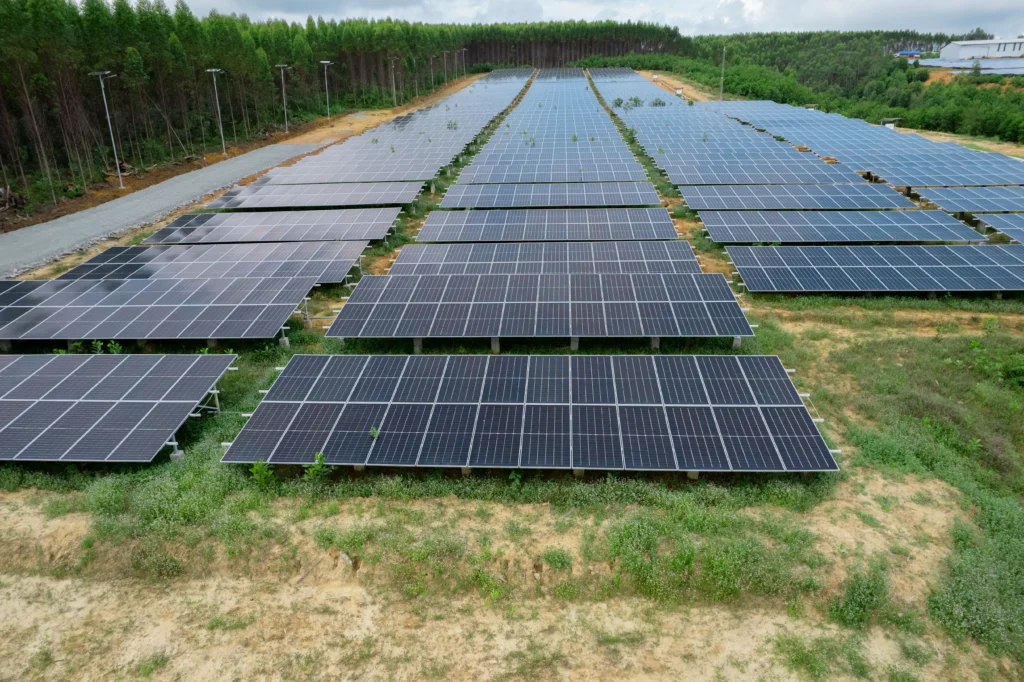
Solar farmin Indonesia’s Ibukota Nusantara. Source : ptplnr.com
The challenge is clear in electricity grids. ASEAN’s electricity demand is expected to continue growing rapidly, while integrating more renewable energy will require major investment in transmission, distribution and cross-border interconnection. If electricity grids take years longer to build than the factories and technologies they are supposed to support, opportunities will be lost before they become productive assets.
This is an example of why adaptation is fundamentally an institutional challenge. A country can have abundant renewable resources and attract investment in new factories, but still fail to capture the opportunity if the infrastructure and regulatory systems needed to connect those investments cannot keep pace.
The same standard needs to be applied to industrial policy as well. Across the region, governments are competing to attract semiconductor investment, electric vehicle production, data centres, renewable energy projects and other strategic industries. This competition can bring capital, jobs and technology. But investment numbers alone are a poor measure of success.
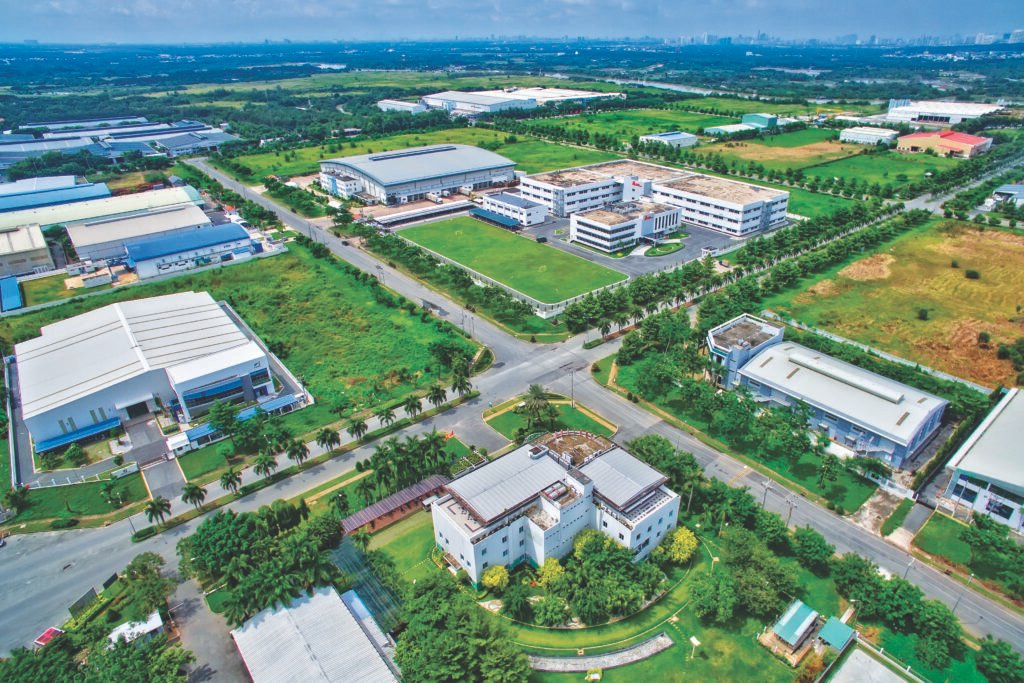
Industrial park in Vietnam. Source : Wikipedia
Vietnam provides a useful illustration. Its success in attracting foreign manufacturing has made it an important part of global production networks, but the next challenge is ensuring that domestic firms capture more of the value generated by those networks. Despite Samsung’s enormous contribution to Vietnamese exports and employment, Vietnamese suppliers initially remained concentrated in relatively low-value activities, while foreign suppliers accounted for much of the domestic value added associated with Samsung’s production. The government has subsequently expanded programmes designed to strengthen local suppliers and help domestic firms integrate more deeply into global value chains.
For Cambodia, Laos and Myanmar, the immediate priority may still be basic infrastructure, human capital, institutional capacity and poverty reduction. For Indonesia, Malaysia, Thailand and the Philippines, the current challenge is about productivity, innovation and moving into higher-value activities. Vietnam is pursuing that transition while integrating further into global manufacturing networks. Their circumstances differ, but the underlying challenge is similar: can institutions evolve quickly enough as the opportunities and constraints facing each economy change?
Rice farmer and field in Laos. Source : Wikipedia
That is ultimately why the middle-income trap is becoming an increasingly unhelpful metaphor for Southeast Asia. It implies a relatively fixed obstacle between middle-income and high-income status. But eventually dynamic is the more vital challenge here. All ASEAN member states need to build economies that can continually reinvent themselves, adjust their institutions, policies, skills and investment priorities as the sources of growth change.
The region’s future prosperity will almost certainly still depend on growth, which is becoming less predictable and its sources are becoming more fluid. In the end, the countries that prosper will be those capable of changing strategy without losing momentum.
Jonathan Manullang is a policy consultant with a background in international development from the University of Edinburgh and a member of the Basic Income Earth Network and Scotland’s International Development Alliance.