It’s difficult to pinpoint a single reason for Jakarta’s persistent traffic problem. It is best to see this issue as stemming from a web of longstanding policy and cultural dynamics that remain unresolved.
Editor Southeast Asia Analyst.
For people living outside its borders, Jakarta might look like Indonesia’s New York City. After all, it is the heart of the republic. It is home to several tall, flashy office towers, bustling business districts, and some very aesthetically pleasing streetscapes. It is also where the young and hopeful migrate to after college, driven by either the pursuit of career opportunities or wanting to make it big in life.
An average working class person in Jakarta, will likely notice that these descriptions of grandeur are, to a certain extent, misleading. While these statements are broadly true, they do not truly capture what it means to live in Jakarta. In fact the best way to describe Jakarta would be traffic congestion.
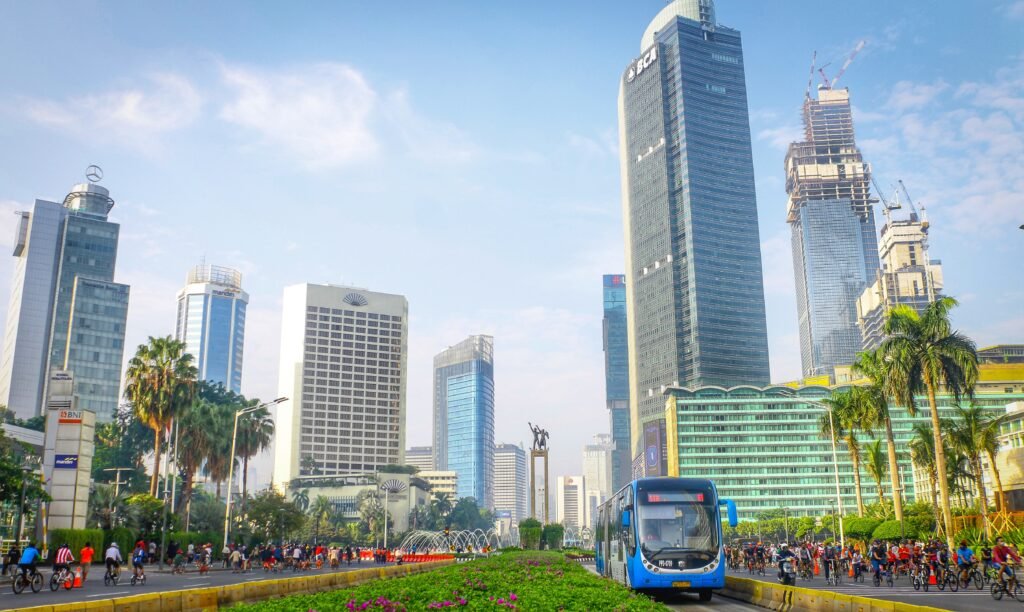
Skyline of Jakarta from Menteng. Source : Wikipedia
Jakarta’s traffic: how bad is it?
As many other capital cities in developing nations, Jakarta suffers from a wide array of governance and infrastructure problems. These pain points would include unequal development, flooding, extreme pollution, and an overabundance of solid waste, among others. Despite these issues, Jakarta’s chronic traffic congestion still reigns as the first among equals.
In 2025, the TomTom Traffic Index ranks Indonesia as the world’s 24th most congested city. This is a significant rise from the previous year’s rankings, where the city placed 90th. Furthermore, this index—which also averages congestion levels, distances driven, and speeds—estimates that a person living in Jakarta would spend around 26 minutes to cover a distance of 10 kilometers. To put this into perspective, if a person were to commute 20 kilometers to work every day, they would spend around 228 hours—or up to ten full days—in traffic annually. If this number is multiplied by 40 (which is the number of years a person works in average), it comes up to am estimate of 380 days. That’s more than an entire year lost to congestion.
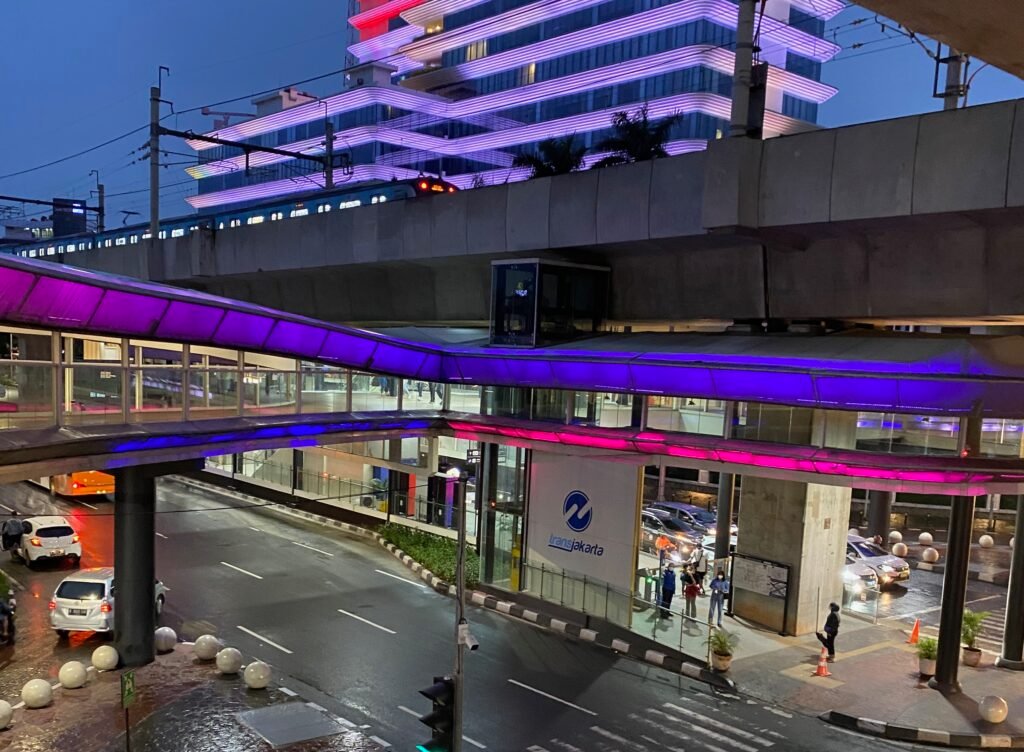
Transjakarta and MRT exchange station in South Jakarta. Source : Wikipedia
Jakartans need not add all these numbers to know that traffic here is just that severe, and they typically compensate by seeking out public transportation options. Services provided by Transjakarta, KAI, MRT, and the LRT assist the working class by making travel cheaper and more efficient. However, this isn’t to say that these public transport ecosystems are without its challenges: unequal infrastructures, peak-hour overcrowding, and first- and last-mile accessibility issues still riddle this growing network.
It is reasonable to assume that these traffic and mass transit gaps are felt most severely by workers commuting from Jakarta’s metropolitan region. For instance, residents of Gading Serpong who work in South Jakarta’s Tanjung Barat region would need to take at least two Transjakarta buses and three different railway lines. Subsequently, they would need to spend at least five hours daily for a round trip. In other words, a certain worker out there could likely spend six years in traffic by the time they retire.
Learning from our neighbors
To further illustrate Jakarta’s congestion chaos, it would do much good to see how its Southeast Asian neighbors are faring. As one of the world’s smallest nations, Singapore is forced to contend with a population density of about 8,300 people per square kilometer—which also makes it one of the world’s densest. Paradoxically, Singapore is also relatively the world’s least congested major city. Numerically, Singaporeans save up to twenty minutes on a 20-kilometer journey during evening rush hour compared with commuters in Jakarta. It also records an 84% congestion level, as opposed to the latter’s 120%. In 2025 alone, Singaporeans lose roughly 163 hours in traffic, while their Indonesian counterparts a staggering 250 hours.
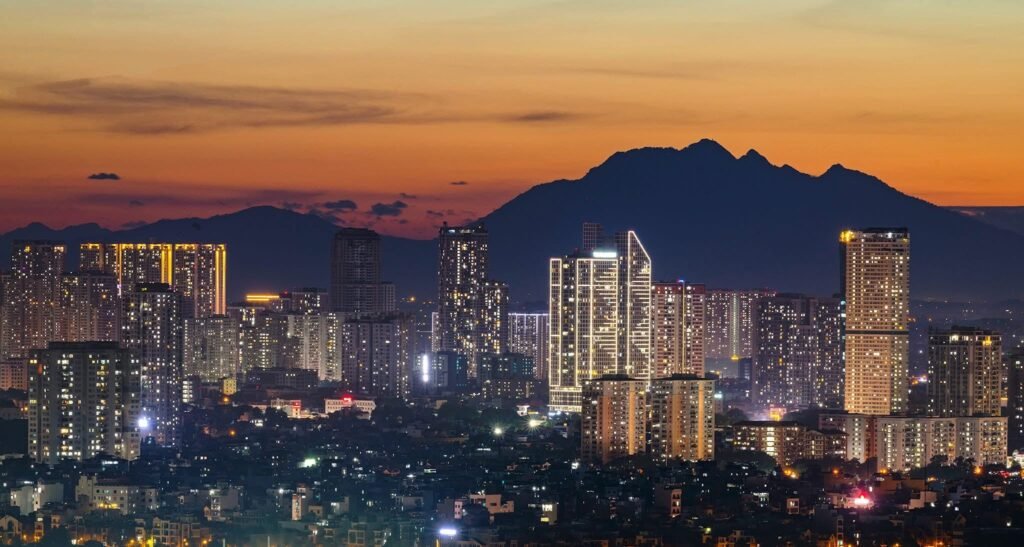
Hanoi Skyline. Source : Wikipedia
One might question of this reduction in congestion could be attributed to Singapore’s population density, which amounts to half of Jakarta’s. This is not necessarily the case. Ha Noi’s population density is approximately a third of Singapore’s, and yet it remains more congested. The same is true for places like Bangkok and Davao City. During rush hours, Ha Noi seems to even surpass Jakarta’s average 20-kilometer travel time, a city seven times denser. These facts, clearly demonstrate that population density alone does not account for why some cities experience higher levels of congestion than others.
Why is all this important?
Before further investigating reasons behind Jakarta’s traffic gridlocks, it is equally important to briefly outline the benefits of having unimpeded roads. Having less traffic entails an increase in worker productivity; with clearer roads, workers have more time to get things done. People would also have to generally spend less on automobile maintenance and refilling fuels. Furthermore, by investing in transit infrastructures, society would yield more jobs and crank up property values, as transit-friendly areas tend to have more appeal than poorly connected districts. From environmental and health perspectives, fewer vehicles on the road could also lead to significant declines in pollutants, thus decreasing the risk of hypertension and heart disease among the population. One study also outlines how excessive traffic noise could contribute to depression and anxiety for certain individuals.
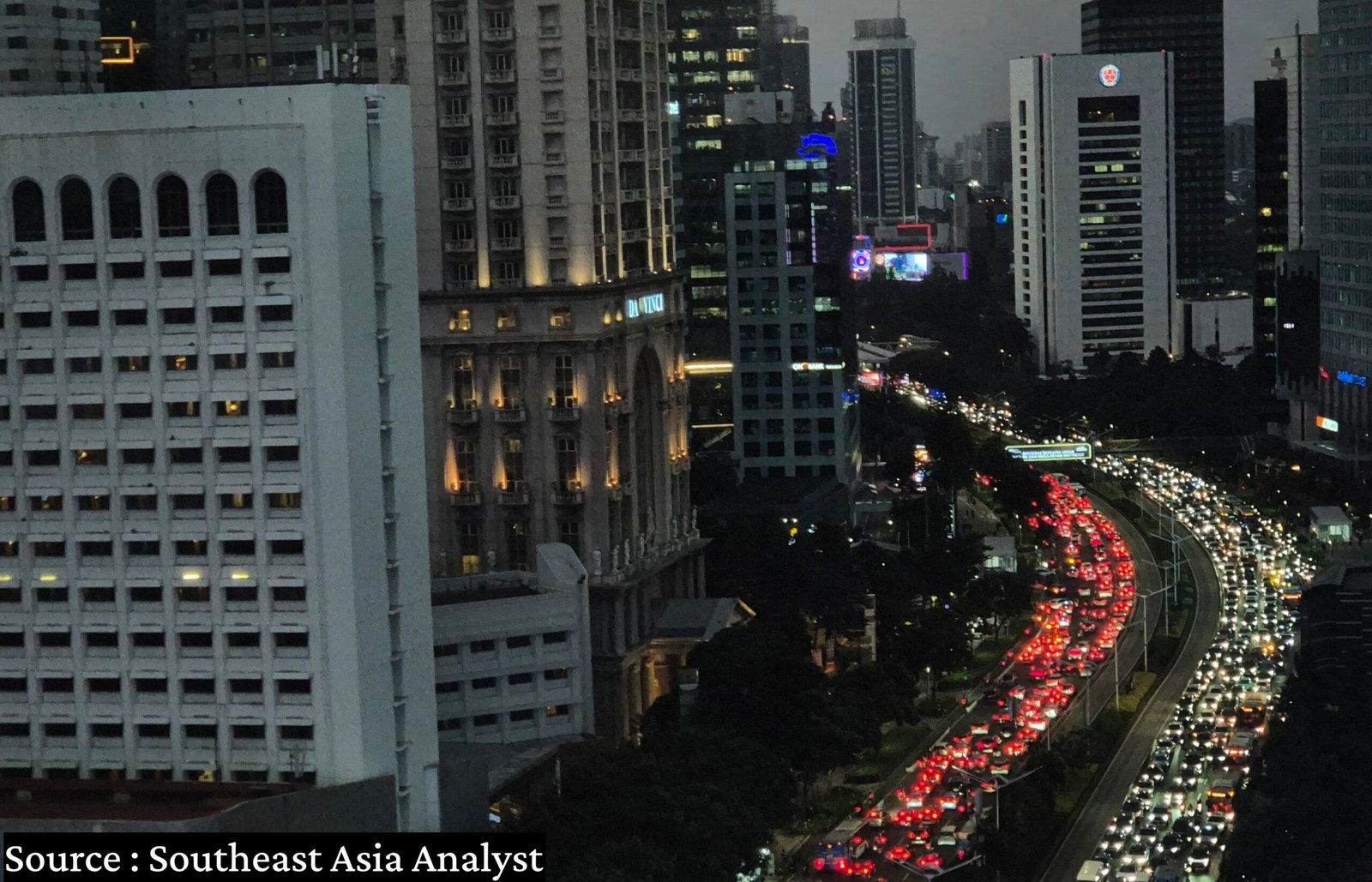
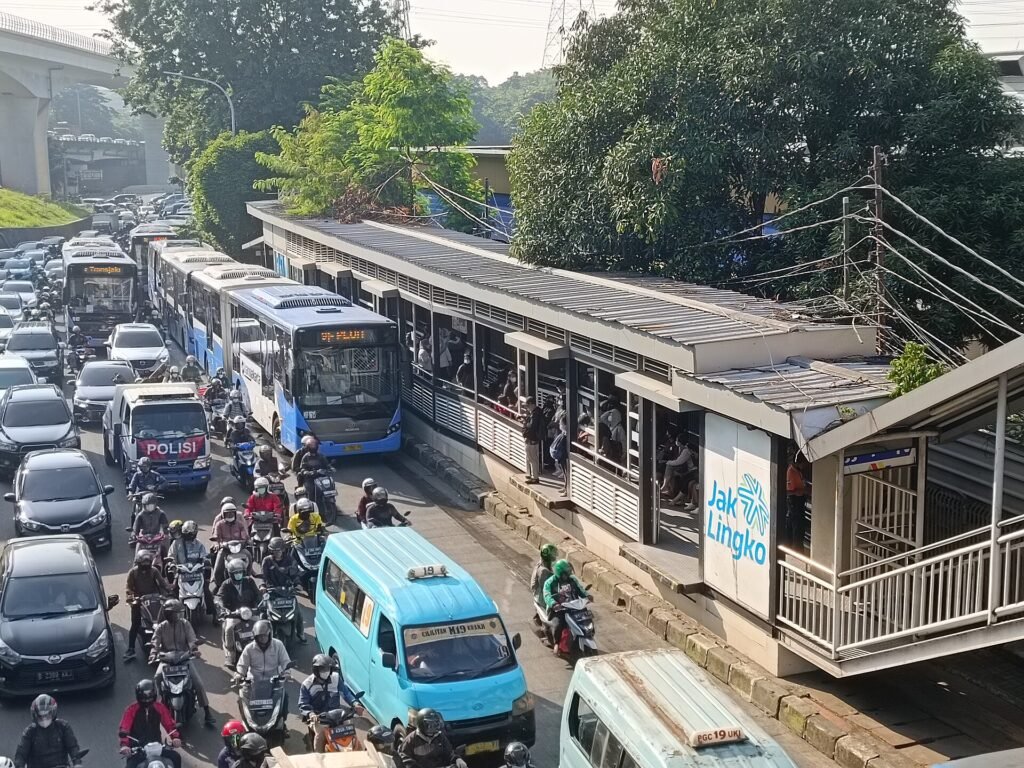
Traffic congestion in Jakarta during peak hours. Source : Wikimedia Commons
How can Jakarta get out of this?
It’s difficult to pinpoint a single reason for Jakarta’s persistent traffic problem. It is best to see this issue as stemming from a web of longstanding policy and cultural dynamics that remain unresolved. However, there are several notable factors contributing to Jakarta’s congestion, as well as potential solutions to address them.
Concentrated economic activity
It is a given that Jakarta and its metropolitan region is Indonesia’s economic center. However, the city’s largest strength is also its Achilles’ heel: it is precisely because of its economic prominence that Jakarta has become the congested city it is today. Economic concentration demands a larger number of workers, not just from surrounding regions, but from all across Indonesia. Most of these workers are forced to commute between suburban areas and Jakarta for work. This explains why Jakarta’s transport arteries are so heavily congested. To mitigate this problem, then Indonesia needs to consider pushing economic activity beyond its metropolitan region and, eventually, beyond Java itself. Surabaya, for example, has gained a reputation for being Indonesia’s second largest economic hub. In Sumatra, Medan’s considerable regional GDP also enables it to function as an economic hotspot in the future. By establishing work centers, improving infrastructure, and clustering industries, Indonesia would divert the influx of workers elsewhere, reduce traffic in Jakarta, and promote equitable growth.
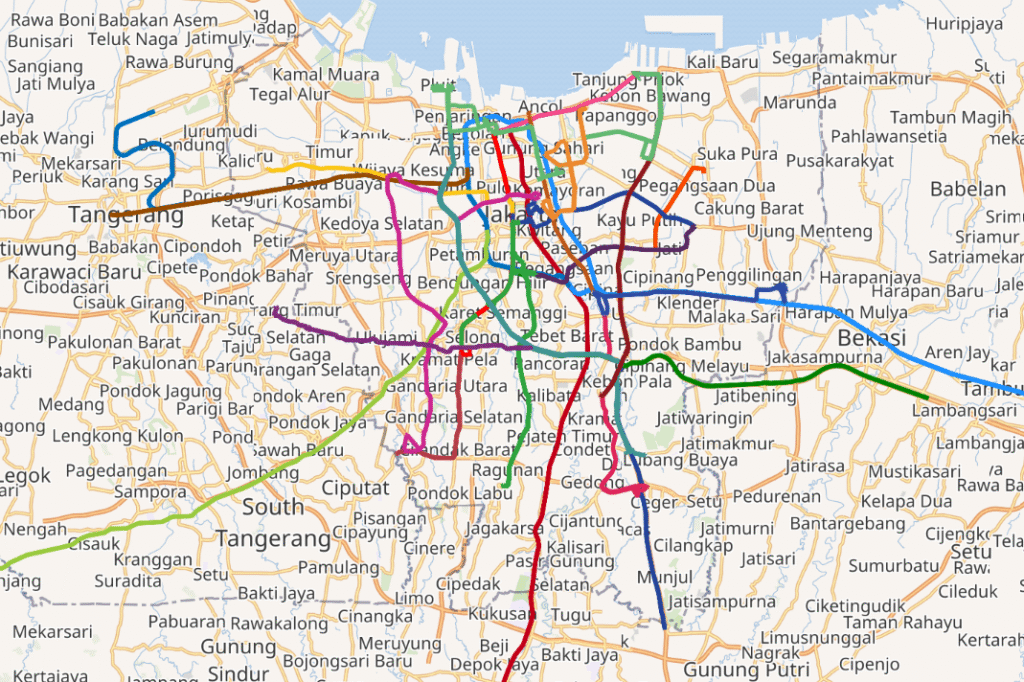
Network of LRT, MRT and KRL railways in Jakarta Metropolitan Region. Source : openstreetmap.org
Incomplete public transport infrastructures
Singapore’s ability to mitigate congestion is a result of good infrastructure investments. The city-state boasts an end-to-end railroad network comprising over 170 MRT stations over six lines, 40 LRT stations across two lines, and a bus network that covers the entire island. Singapore has also successfully managed to create a system that focuses on providing convenient trips and seamless transfers for its residents. In contrast, the Jakarta Metropolitan Region (which is nine times larger than Singapore) only houses around 109 railway stations and continues to struggle with overcrowding, poor transit system integration, and first- and last-mile connectivity challenges. Moreover, while Indonesia has seen improvements in other public transport services, many of these developments are relatively recent, and their long-term impact remains to be seen. To truly promote public transport use, Indonesia first needs to identify places that remain isolated from the system and develop transit points connecting them to the broader network. It also needs to see available public transport services as part of an integrated network designed to move residents safely and conveniently. Only with this mindset could the government then engineer a gapless network that serves as a preferable alternative to driving.
Car ownership policies
Jakarta’s congestion has also been affected by pursuing policies that encourage private vehicle ownership, which is done by making vehicle financing broadly available and investing heavily in road infrastructures. In 1981, Indonesia had just about one million cars. Forty years later, and this figure has soared to twenty million cars and 140 million motorcycles. Furthermore, Indonesia has also invested significantly in the road construction, as opposed to mass transit infrastructure, which is exceptionally evident during President Joko Widodo’s administration. While connectivity does support economic growth and reduce congestion momentarily, it often induces additional traffic in the long run. By incentivizing vehicle use, Indonesia has encouraged greater reliance on cars and motorcycles, amplifying urban traffic. Conversely, Indonesia should consider applying deterrents to driving. This may include Singapore’s road pricing model, which increases rates during rush hours, or Japan’s time-based parking fees, which fluctuate between peak and off-peak periods. It is important to note, however, that these solutions would only work with the presence of integrated public transport systems. If we were to proceed without them, then Indonesia would effectively murder its own economy, and the livelihoods of its workers.
Darren Christopher is the co-founder of KataKarsa, an op-ed platform aimed at advancing democracy in Indonesia. He is also a philosophy, sustainable development, and RPG enthusiast.