Fast forward to 1959, Chinese-majority Singapore was granted greater self-rule within the Commonwealth – the newly elected People’s Action Party-led government of Lee Kuan Yew controlled internal affairs, while the United Kingdom oversaw the island’s defense and foreign policy. In the following years, the PAP was beset by political problems after losing the Hong Lim and Anson by-elections and intra-party conflict led to the expulsion of leftist factions around Lim Chin Siong and his allies who later regrouped as the Barisan Sosialis (Socialist Front). Around this time, the PAP was on the verge of losing power it had consolidated after its landslide victory two years prior. Subsequently, the PAP devised the idea of merging with Malaysia as a solution.
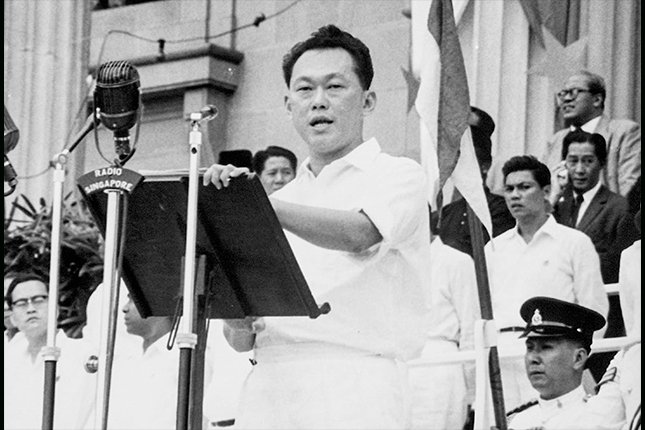
Lee Kuan Yew gives a speech as paramount leader of Singapore. Source : roots.gov.sg
Soon after, Singapore’s democratic trajectory ended before it could develop. The PAP was able to convince the ruling United Malays National Organization that Singapore’s left-leaning, Chinese-majority electorate will be politically quarantined on the island so as not to threaten the electoral dominance of the latter at the federal level. This was decisive in convincing UMNO to accept Singapore into the Federation of Malaysia in 1963. Meanwhile, the PAP sidelined the opposition and reconsolidated its political dominance. Nevertheless, Barisan Sosialis rightly argued that the inclusion of Singapore into the Federation built on the principle ofketuanan melayu (Malay ethnic supremacy) would prove to be unworkable. The tensions between the PAP and UMNO especially on the question of ethnic equality and the former’s political course destabilized the political arrangement and led to race riots in 1964 as well as 1969 (well after Singapore’s negotiated exit from Malaysia). The PAP sought to aggressively transform Malaysia into a socialist Malaysia for all ethnic groups which brought them into confrontation with UMNO elites who wanted to maintain Malay special privileges. After two years of political conflict with UMNO, the PAP undid the very arrangement it created as it proved to be untenable and established a new Singapore republic in 1965.
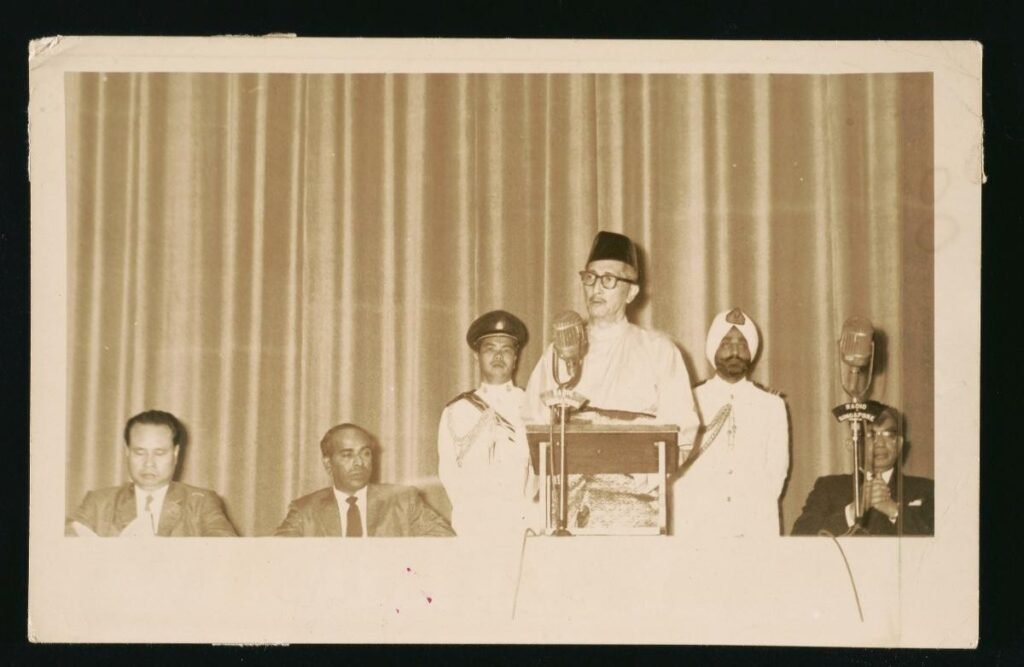
Singapore’s first president Yusof Ishak. Source : roots.gov.sg
For the longest time, the PAP has always campaigned on liberal principles of equality regardless of race, religion and language and attempted to cement them in Singapore’s national consciousness. At the same time, authoritarianism was deemed necessary to maintain the delicate “racial harmony” lest different ethnic groups descend again into primordial violence which had more to do with politics than ethnicity. To make good on the promise, Malay remained Singapore’s national language after 1965 and Yusof Ishak, a Malay journalist, was appointed as Head of State. The constitutional amendment of 1969 also birthed the Presidential Council for Minority Rights which ensures that parliamentary legislation does not harm any ethnic or religious group and can veto any law if such issues arise (interestingly, there has never been an adverse report nor a veto). English became the sole medium of instruction to foster a common language. Housing Development Board estates have mandated ethnic quotas to reflect the ethnic composition of the city-state. Group Representation Constituencies – constituencies in which teams of candidates of one party compete against other parties for multiple parliamentary seats as opposed to Single Member Constituencies – require the inclusion of Malay, Indian or other ethnic minorities in a party’s electoral list to ensure minority representation in parliament.
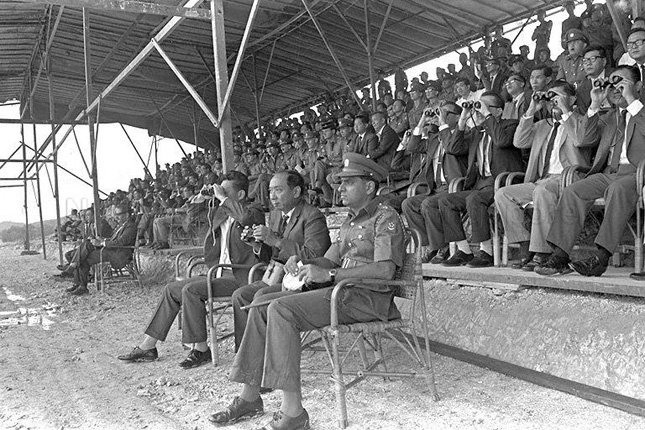
Lee Kuan Yew and Defense Minsiter Goh Keng Swee inspect troops. Source : roots.gov.sg
Despite the existence of these very institutions, discriminatory practices that run counter to the supposed founding ideals of Singapore continue to permeate state and society. Malay Muslims seem to be absent from senior leadership roles in the Singapore Armed Forces and the Airforce, given decades of unofficial exclusion of Malay Muslims from the SAF and the police after reconstituting the Republic in 1965. The PAP still insists that Singapore, 61 years after its refoundation, is yet to be ready for an ethnic minority prime minister. Special Assistance Plan schools offering a bilingual curriculum in English and Mandarin exist, whereas comparable programs do not exist for Malay or Tamil, strengthening spatial segregation between Chinese, Malay and Indian Singaporeans. Anecdotal evidence also points to Mandarin language requirements on the labor market as well as housing discrimination when renting out. In “multiracial” Singapore, Chineseness takes up a hegemonial position in daily social and political life, relegating ethnic minorities to the margins under the veneer of meritocracy.
No one embodied the belief in ethnic Chinese superiority deeper than Singapore’s eminent leader, Lee Kuan Yew. Therefore, if Singapore was to remain a highly competitive industrialized economy in the global capitalist system, ethnic Chinese immigration should be encouraged.
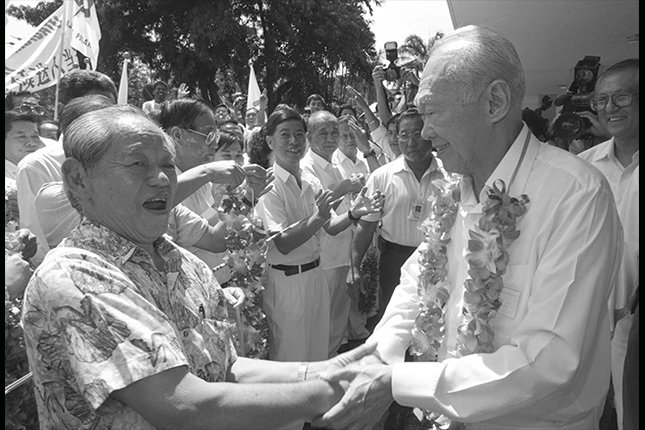
Lew Kuan Yew in People’s Action Party Rally. Source : roots.gov.sg
Selective ethnic immigration policy became the favored tool to maintain Chinese ethnic majority in the face of declining fertility rates and the emigration of highly skilled Singaporeans. Firstly, Chinese Malaysian immigration across the causeway was encouraged and produced little friction within Singaporean society due to the perceived proximity in culture and history. However, Chinese Malaysians face increasingly the same demographic issues as those of Chinese Singaporeans. Thus, beginning in the 80s, in anticipation of the 1997 handover of the British colony of Hong Kong, systems were put in place that fast tracked immigrants’ Permanent Residency and naturalization. Over the decades, the same policy tools were redirected at immigrants stemming from China, which ironically have created social conflicts not only with Malay and Indian Singaporeans, but also the Chinese Singaporeans whose majority the political elites are trying to preserve.
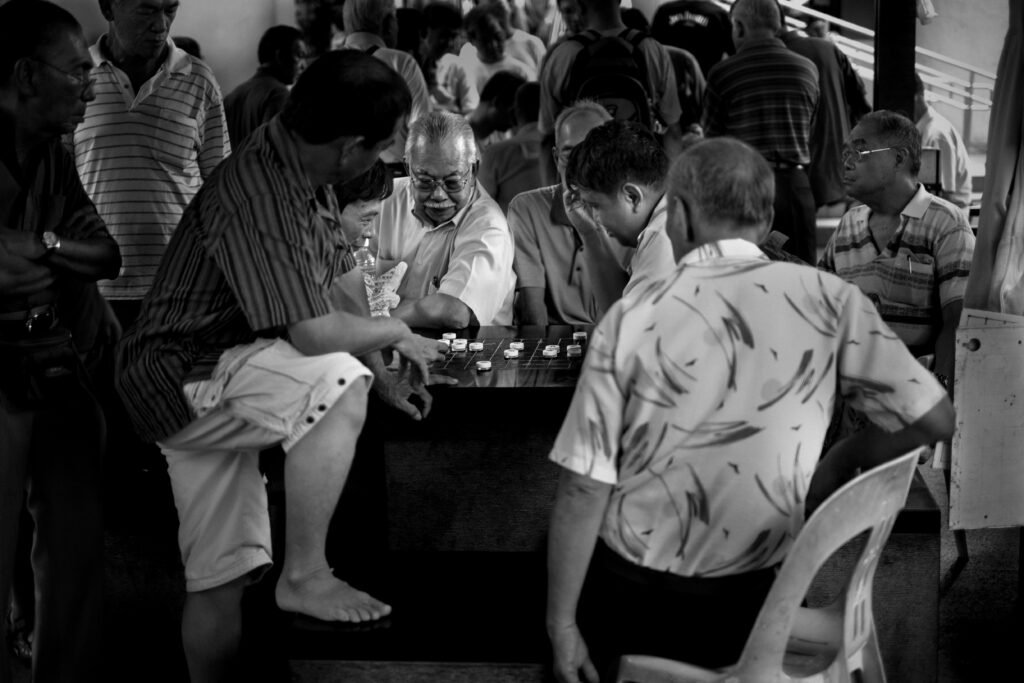
Chinese Singaporeans playboard games in hawker center. Source : Wikimedia Commons
Path dependencies created during British colonial rule of Malaya have historically disadvantaged the Malays of Singapore. During the first decade of the republic’s founding, Malays were excluded from attaining university-level qualifications as a result of language barriers while Nanyang University offered degrees solely in Mandarin and the University of Singapore had English as its language of instruction which only enabled mostly Chinese and Indian Singaporeans to acquire tertiary education. Added to that, the prevailing myth of the lazy (Malay) native, who is allegedly less industrious as well as more self-indulgent that structure political thinking among the regime elites influences and rationalizes societal discrimination and the highly selective but ethnic immigration policy Singapore has today. Neither authoritarianism nor ethnic Chinese majority is a recipe for economic success. Nor is it a guarantor of “racial harmony”. Rather, Singapore’s journey to become an advanced capitalist country was a result of the sacrifices borne by Singaporean workers acting at the behest of the state, policies set out by the dominant political party and its position in global capitalism aided by Euro-American hegemony.
Ryan Sachio Tan is a soon to be fresh graduate of political science and German linguisitics. His interests are Indonesia, Chinese-Indonesian and Thailand.