Taking the tools offered by Indonesia’s democratization, these Chinese Indonesians process the trauma borne from 1965–1966 purge of the Indonesian left, the New Order and 1998 and cross the ethnic line to rethink narratives of what it means to be Chinese Indonesian today.
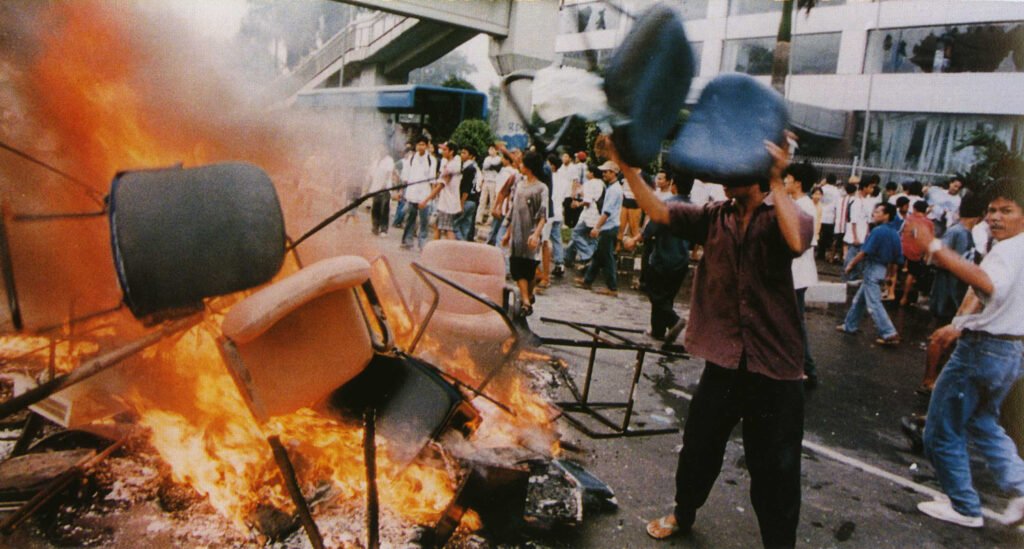
Jakarta riots in May 1998. Source : Wikimedia Commons
Some paid handsomely for securing the perimeter around residential areas in Sunter, but had their houses sacked and engulfed in flames. Escaping across Lake Sunter on foot, some would notice tanks from the TNI (Indonesian military) in position, but somehow not intervening to quell the violence that ensued. Others quickly sold valuable assets to escape the fate bestowed upon other Chinese Indonesians. In places such as Bali, the situation was calmer than in Medan (North Sumatra) and Jakarta. For those who could afford it, Singapore, Hong Kong, Australia, Canada and the United States became prime destinations for refuge, as news also spread of systematic patterns of sexual assault of Chinese Indonesian women spread.
Some, who refused to leave, barricaded and organized themselves in neighborhood watches such as at Kelapa Gading in North Jakarta. As mobs closed in from Sunter and Pulo Gadung in East Jakarta, Kelapa Gading administrators with military connections may have offered generous sums of security money, so that on the night of May 14 the local military garrison intervened to stop the violence at its doorstep.
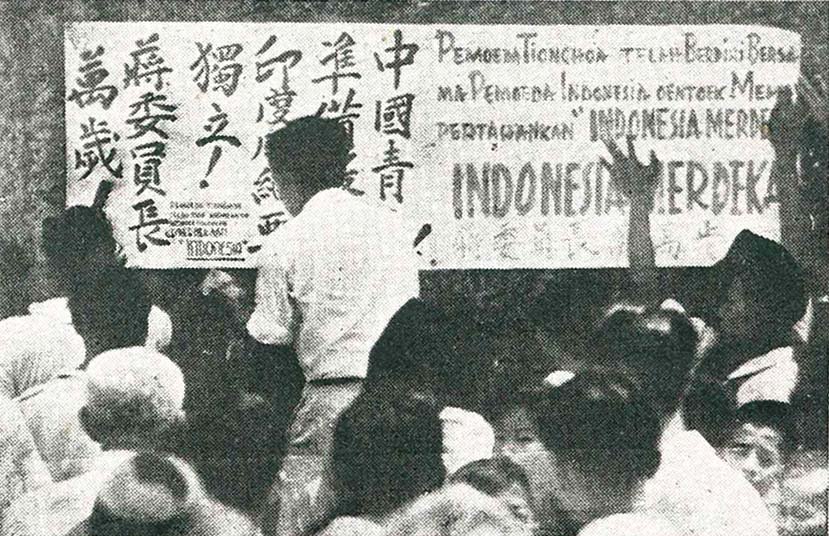
Poster translation. “Chinese youth stands with Indonesian youth to achieve Indonesian Independence” Source : Wikimedia Commons
In the book, she tries to explain how political, social and historical conditions since Dutch colonization and over the course of the New Order regime have shaped the Chinese Indonesian habitus. The term introduced by Pierre Bourdieu refers to, in this context, the internalized habits, skills, and dispositions Chinese Indonesians acquire through their social background and environment. In other words, it describes how Chinese Indonesians move through the world without consciously thinking about their everyday choices, tastes and behaviors as well as the boundaries set between the Chinese Indonesian habitus and the non-Chinese Indonesians occupying outside it.
Setijadi’s work is one of the most important references in order to understand Chinese Indonesians today, an ethnic group (if we can call it as such due to the existence of various ethnolinguistic groupings within this category,) arguably most scrutinized since the dawn of the Indonesian Revolution. She traces the most direct implications of May 1998 in the physical architecture meant to ensure Chinese Indonesian safety be it in the tall metal gates of Glodok or in the network of paid security personnel and even taller concrete walls separating the bourgeoisie of Kelapa Gading from the outside world.
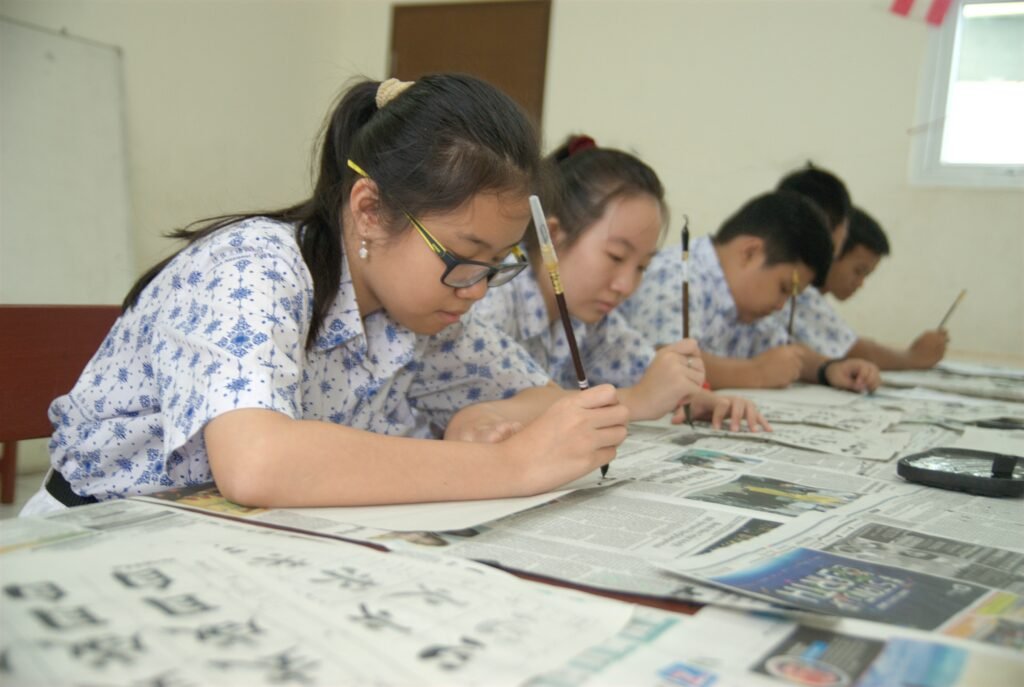
Indonesian students practicing Chinese calligraphy. Source : Wikimedia Commons
Chinese Indonesian Muslims such as Siauw Chen Kwok (or Felix Siauw 蕭正國) remain a rarity in Indonesia’s religious landscape. Most are Protestants, Roman-Catholics, Buddhists or followers of Chinese folk religion. Most also avoid public schools and prefer private schools, some of which offer full curricula in Mandarin Chinese. Therefore, universities could become the first sites where Chinese Indonesians and non-Chinese get to form relationships with each other. The existence of the boundaries between the habitus and the rest of the world also bleed into the types of social circles, romantic relationships, friends, spouses, and partners Chinese Indonesians engage in.
Across various aspects of Chinese Indonesian social, political, and economic life, Setijadi presents us the intergenerational inheritance of memories, value systems, and capital which are tied to particular spaces. The borders surrounding the habitus and collective social behavior are maintained through narratives of victimization. Not all Chinese Indonesians, however, feel shackled by the rules set by the habitus. Taking the tools offered by Indonesia’s democratization, these Chinese Indonesians process the trauma borne from 1965–1966 purge of the Indonesian left, the New Order and 1998 and cross the ethnic line to rethink narratives of what it means to be Chinese Indonesian today.
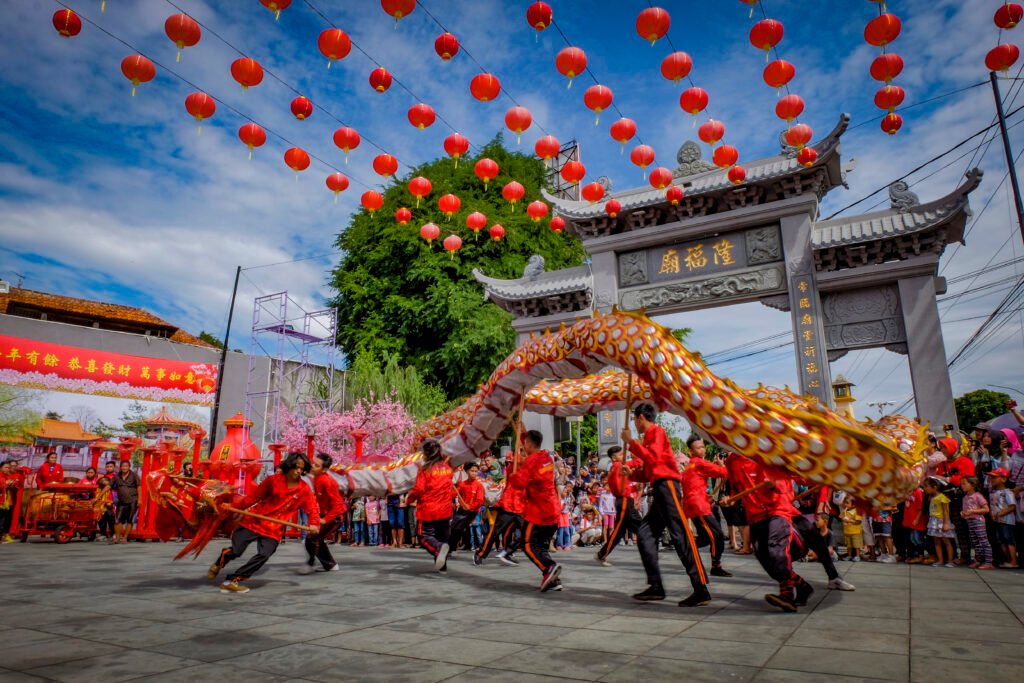
Dragon dance infront of Glodok, Jakarta Chinatown. Source : Wikimedia Commons
The questions becomes even more pressing in light of China achieving parity with the United States and trends of re-sinification among Chinese Indonesians motivated by their desire to reclaim a lost identity after decades of forced assimilation policies during the authoritarian period, on the one hand, and exploiting China’s capitalist development for their own economic interests, on the other hand. Coupled with the state of social segregation between Chinese Indonesians and non-Chinese as a norm today, closeness with China “may be dangerous for Chinese communities in countries with long histories of anti-Chinese sentiment such as Indonesia”.
While it is impressive that Setijadi was able to cover extensively multiple dimensions of Chinese Indonesian identity politics including Chinese Indonesian political representation, social organizations, and art, her book, through no fault of her own, fails to capture the experiences of working class Chinese Indonesians as well as of those outside Java and Sumatra. The power to construct the boundaries of the Chinese Indonesian habitus seem to lie in the hands of bourgeois and petite bourgeois members of the community concentrated in urban areas.
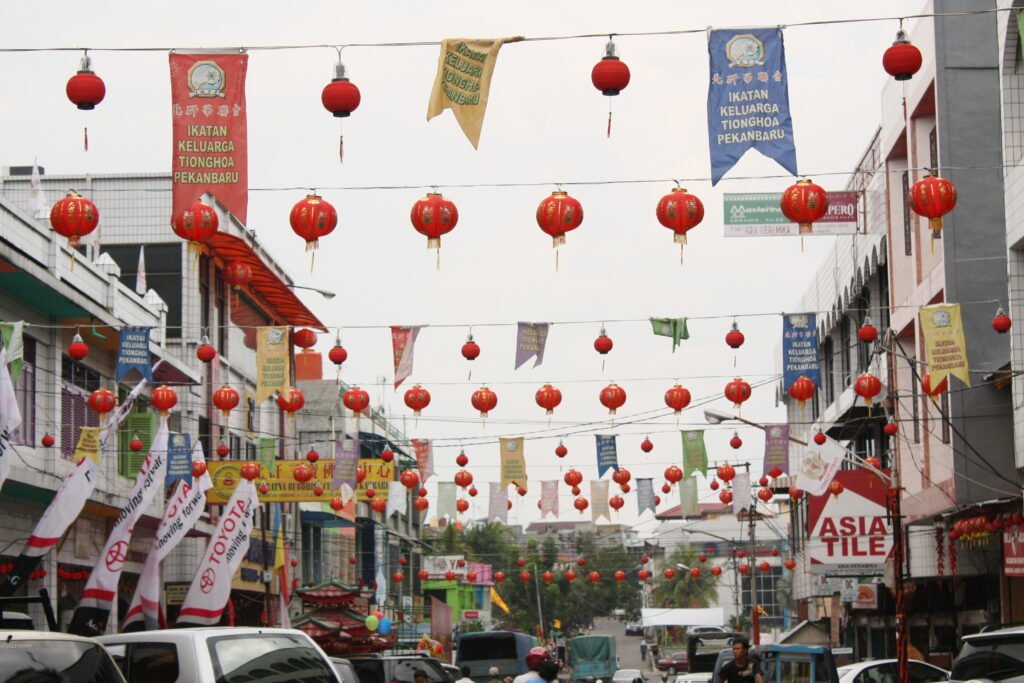
Chinese new year celebration in Pekanbaru, Sumatra. Source : Wikimedia Commons
In contrast, Chinese Indonesian workers are hampered in their participation of the habitus by their lack of economic resources and may exhibit other forms of relationships with non-Chinese citizens. Non-Chinese-Chinese relations could manifest themselves differently the further we move into Borneo and the East. Nevertheless, Setijadi’s book is required reading for those who are interested in Chinese Indonesians in the 21st century and those who wish to contextualize their own social upbringing and place in society.
Ryan Sachio Tan is a soon to be fresh graduate of political science and German linguisitics. His interests are Indonesia, Chinese-Indonesian and Thailand.