Rather than reducing reliance on foreign energy, Singapore is actively expanding it through cross-border grid integration.
Editor – Southeast Asia Analyst.
Energy independence is often seen as the ultimate form of energy security. If a country can produce its own energy, it need not worry about foreign suppliers, geopolitical tensions, or disruptions in global markets. Following the global energy crisis triggered by Russia’s invasion of Ukraine in 2022, many governments renewed efforts to reduce their dependence on imported energy. Singapore, however, appears to be taking a different approach.
Earlier this year, Prime Minister Lawrence Wong outlined Singapore’s energy strategy and stressed that the country “cannot depend on any single fuel source, supplier, or technology”. Instead, Singapore would pursue “multiple pathways” to secure its energy future. The statement highlights an important reality, Singapore is not trying to become energy independent. It is trying to become energy resilient.
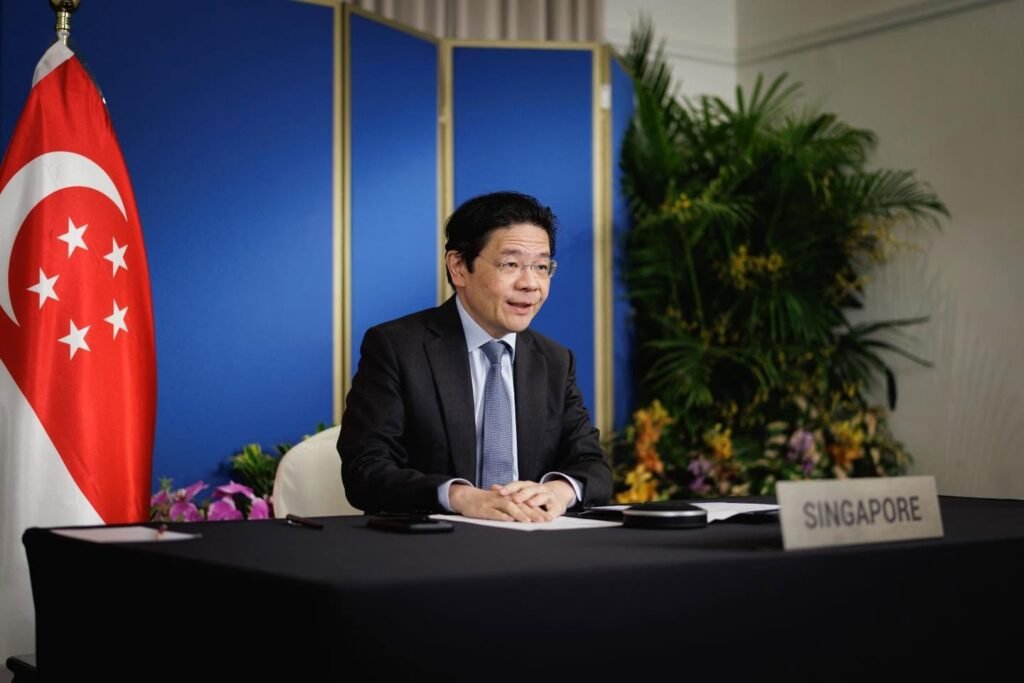
Prime Minister Lawrence Wong in a virtual meeting. Source : Wikimedia Commons
Part of the reason is simple geography. Singapore lacks the natural resources needed to achieve meaningful energy self-sufficiency. It has no significant oil, gas, or hydropower resources, while its small land area limits the deployment of renewable energy. Solar power remains Singapore’s most promising domestic energy source, but even according to the Energy Market Authority, it may supply only around 10% of Singapore’s electricity needs by 2050.
Yet geography alone does not explain Singapore’s energy strategy. Many countries face resource constraints without making external dependence a central feature of their energy policy. What makes Singapore different is that its leaders have chosen to embrace interdependence rather than avoid it.
This can be seen in the government’s Four Switches strategy, which guides Singapore’s energy transition. Alongside natural gas and solar energy, regional power grids are identified as a key pillar of the country’s future energy system. In other words, importing electricity from neighbouring countries is not a temporary solution until Singapore finds something better. It is already part of the long-term plan.
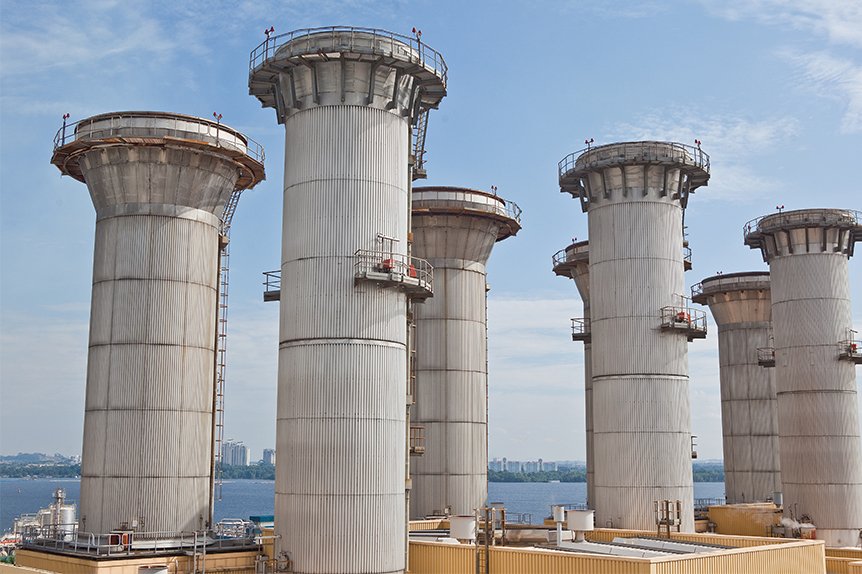
Senoko Power Station in Singapore, powered by natural gas from Malaysia. Source : Wikimedia commons
The clearest evidence comes from Singapore’s electricity import ambitions. In 2025, the government raised its low-carbon electricity import target from 4 gigawatts to 6 gigawatts by 2035. If realised, imported electricity could supply roughly one-third of Singapore’s power needs. This is a remarkable target for a country supposedly pursuing energy independence. Rather than reducing reliance on foreign energy, Singapore is actively expanding it through cross-border grid integration.
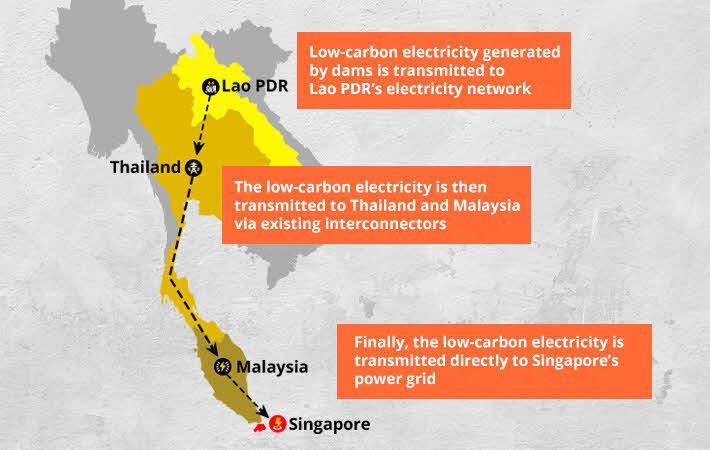
Singapore is also investing political and economic capital into regional energy integration projects. The Lao PDR-Thailand-Malaysia-Singapore Power Integration Project (LTMS-PIP) has already demonstrated that electricity can be traded across multiple Southeast Asian countries. At the same time, Singapore continues exploring electricity imports from Indonesia, Sarawak, Cambodia, Vietnam, and Australia. These initiatives support the broader ASEAN Power Grid vision, which seeks to connect electricity networks across the region.
Info-graphic on The Lao PDR-Thailand-Malaysia-Singapore Power Integration Project (LTMS-PIP). Source : ema.gov.sg
Critics may argue that depending on foreign electricity creates new vulnerabilities. They are not entirely wrong. Energy imports will always carry risks. However, Singapore’s strategy suggests that dependence itself is not the problem. Dependence on a single source is.
A country that relies on one fuel, one supplier, or one technology can be severely exposed when disruptions occur. By diversifying its suppliers and connecting itself to multiple energy sources, Singapore hopes to spread that risk rather than concentrate it. In such a system, disruptions affecting one supplier can potentially be offset by alternative sources elsewhere.
For Singapore, energy security is no longer about producing everything at home. The country lacks the geography and resources to make that goal realistic. Instead, it is building a system designed around flexibility, diversification, and regional cooperation. While many countries continue to chase energy independence, Singapore is pursuing something different: the ability to withstand disruptions regardless of where its energy comes from. In that sense, Singapore’s energy future is being built not on independence, but on diversification.
Khairan Nurfikri is a student of international relations from Universitas Padjadjaran